Monday, June 8, 2020

Mountings and Accessories of steam Boiler


Mountings of Steam  Boiler :-

The boiler mountings are the part of the boiler and are required for proper functioning. In accordance with the Indian Boiler regulations, of the boiler mountings is essential fitting for safe working of a boiler.

The following mountings are required to operate the steam boiler safely,

  1. Water Level Indicator
  2. Pressure Gauges
  3. Safety valves
  4. Temperature Gauges
  5. Fusible Plug
  6. Blow Off Cock Valve
  7. Feed Check Valve
  8. Steam Stop Valve 
  9. Air Vents
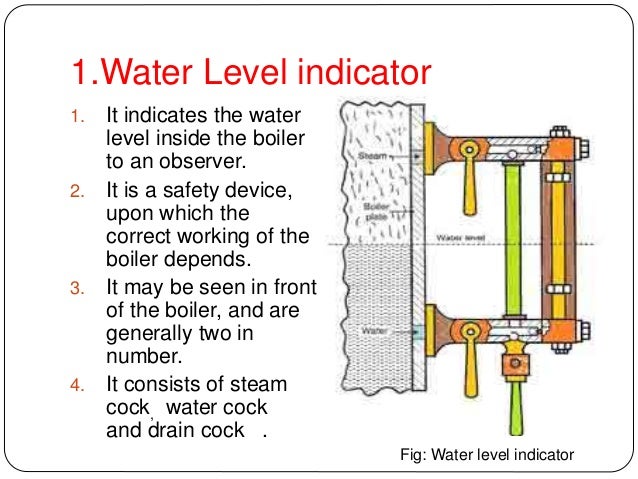
  • Water Level Indicator
IBR Boiler Reflex Gauge GlassWater level indicator is located in front of boiler in such a position that the level of water can easily be seen by attendant.  Two water level indicators are used on all boilers as per IBR guidelines.The boiler shall have the lowest visible part of the water gauge located at least 25 mm above the lowest permissible of water level.
boiler mountings & Accessories


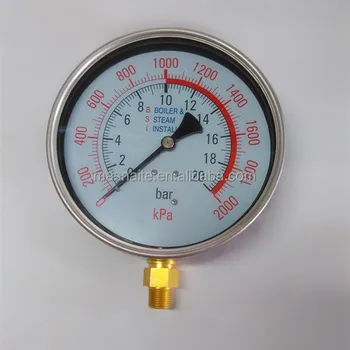
150mm Steam Boiler Pressure Gauge
  • Pressure Gauges 
A pressure gauge is fitted in front of boiler in such a position that the operator can conveniently read it. It reads the pressure of steam in the boiler and is connected to steam space by a siphon tube. The gauge mounting with a isolation valve. The most commonly, the Bourdon type pressure gauge is used.
As per IBR guidelines, the operating and maximum pressure marking should be done on gauge with the RED, the pressure gauge shall be calibrated within an accuracy +/- 1%. Boiler pressure gauges shall not be less then the 150 mm diameters. 
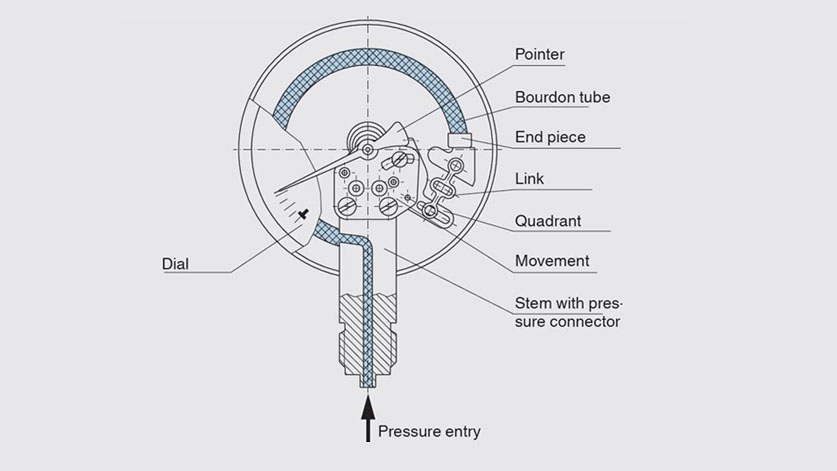
Bourdon tube pressure gauge - operating principle - WIKA blog


  • Safety Valves

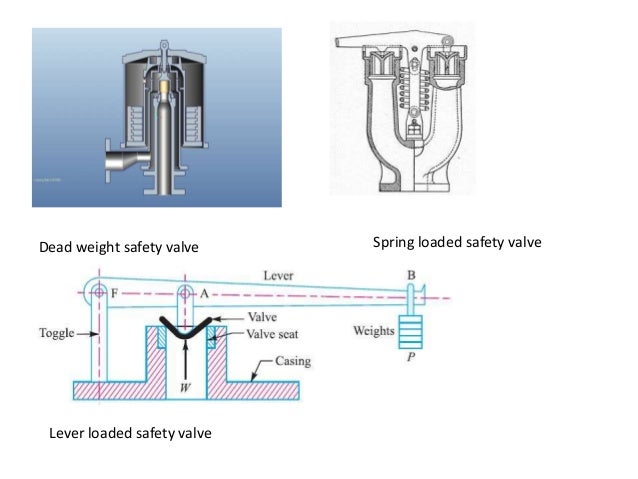
Safety valves are located on the top of the boiler drum. They guard the boiler against the excessive high pressure of steam inside the drum. If the pressure of steam in the boiler drum exceeds the working pressure then the safety valve allows blow-off the excess quantity of steam to atmosphere. Thus the pressure of steam inside the drum falls down. The escape of steam makes a audio noise to warm the boiler attendant. 

As per IBR guidelines, The safety valves shall be reset at a pressure at least 2.5% below. but not more than 5% below the safety valve set pressure. Safety valves should always be mounted in a vertical position to avoid influencing the valves set pressure.

There are four types of safety valve.
  1.  Dead weight safety valve. 
  2.  Spring loaded safety valve 
  3.  Lever loaded safety valve
  4.  High steam and low water safety valve.
Boiler mounting


Accessories of Steam Boiler :-

The accessories are mounted on the boiler to increase its efficiency. These units are optional on an efficient boiler. With addition of accessories on the boiler, the plant efficiency also increases but the operation of the plant may be difficult and maintenance cost of the increases, it required skilled person to operate.

The following accessories are generally used in steam boiler,
  1. Economizer
  2. Super Heaters
  3. Air Pre-heater
  4. Feed Water Pump
  5. Chemical Dosing pumps
  6. Deaerator
  7. CBD and IBD system


Sunday, June 7, 2020

Draught System in Thermal Power Plant

Draught System

The function of draught system in thermal power plant is to extract the non combustible products after completely combustion happened in the boiler and then sent into atmosphere at safe elevation through chimney.
Following are the classifications of Draught System's 
  1. Natural Draught System
  2. Mechanical Draught System
Natural Draught System :-
In this system the draught is created by height of the chimney due density difference between the hot flue gases inside the chimney and cold air out side the chimney. The density of hot flue gas is less then the cold air outside the chimney. The natural draught system is lower efficient then mechanical draught system.
Mechanical Draught System:- 
It is the draught artificially produced by rotary fans. And they are classified as follows
  1. Induced Draught
  2. Forced Draught
  3. Balanced Draught
Induced Draught System:-
Induced draught fan is generally located at the out let of dust collector and base of the chimney. The fan takes hot flue gases from the boiler through Economizer, Air-preheater and dust collector and delivers it to the chimney into the open atmosphere. The fan used for this process is known as ID Fan.
The ID Fan creates negative pressure inside the furnace or suction discharge the gases out after complete combustion  from the furnace and it also helps to proper combustion. Since ID Fan can handle the hot flue gases, they have more corrosion and erosion problems even when used with dust collectors. The most common type of fans used as ID Fans are the backward inclined blade centrifugal fans. The controlling of flue gas flow is maintained by the help of inlet pneumatic damper adjustment, fan speed controlled by VFD, Fan speed controlled by scoop coupling.
Forced Draught System:-
The fan used for this process is known as FD Fan.  The FD Fan is draws air from the atmosphere and forces it into the furnace through a air preheater. These fans are located near the boiler and clean area to draw the clean air and push high pressure air  to the combustion chamber, where it mixes with fuel to produce positive pressure. 
The most common centrifugal fans used as FD fans are backward curved and airfoil  centrifugal fans. To control the air flow into the furnace through inlet pneumatic damper control,fan speed controlled by VFD, Fan speed controlled by scoop coupling. 
The FD fan handling the cold air so, it operation and maintenance cost is less comparatively ID Fan. Corrosion and Erosion problems are less.
Balance Draught System:-
In this system the both ID and FD fans are operating simultaneously and draught can be maintained inside furnace such that the +/- 5mmwc. The operating efficiency of boiler with this system is high. The FD fan push the fresh cold atmospheric into the furnace and makes furnace pressure positive due to which the flame coming out of the furnace through manholes, peep holes, expansion  joints. The ID Fan maintains the negative pressure ( below the atmospheric pressure ) inside the furnace such that flame not coming out of the furnace, it makes boiler operation continuously.
Advantageous of Mechanical Draught:- 
The mechanical Draught having a following advantageous,
  1. Easy to control the combustion and evaporation.
  2. Increase in evaporate power of boiler. 
  3. Combustion efficiency of boiler is increases.
  4. It reduces  the chimney height.
  5. Prevention of smoke.


BOE ONE MARK QUESTIONS

1. Specific heat in kCal/kg -0C of fuel oil is in the range of 
 
a) 0.15 – 0.20   b) 0.22 – 0.28    c) 0.29 – 0.32 d) none of the above 

2. Grade B Indian coal has a energy content range (in kcal/kg) of 
 
a) 3360-4200    b) 4200-4900  c) 4940-5600     d) 5600-6200

 3. Which of the following fuel requires maximum air for stoichiometric combustion? 
 
a) Butane        b) Propane  c) Hydrogen        d) Coal  

4. Stochiometric air required for combustion of Bagasse is about 
 
a) 13.7         b) 3.2  c) 6         d) 18

 5. Which fuel releases the most energy per kg on complete combustion 
 
a) Carbon        b) Sulphur  c) Nitrogen        d) Hydrogen 

6. How many kg of CO2   are produced in complete combustion of 16 kg of Methane?  
 
a) 42         b) 44  c) 16        d) none of the above  

7. In flue gas the theoretical CO2 is 15.5% and measured CO2 is 11% by volume. The percentage of excess air will be 
 
a) 40.9%        b) 38.7 %  c) 240.9 %        d) 140.9 % 

8. The lowest excess air is required in a  
 
a) coal burner     b) low pressure oil burner         c) high pressure gas burner  d) high pressure oil burner 

9. Which of the following is not measured in ultimate analysis? 
 
a) carbon      b) sulphur          c) hydrogen        d) ash 

 10. With increase in the percentage of excess air for combustion of coal, percentage of CO2 in flue gas. 
 
a) increases    b) decreases     c) remains same         d) none of the above 

11. Which of the following requires the least amount of oxygen /kg  for complete combustion 
 
a) Carbon      b) Sulphur         c) Hydrogen        d) Methane  

12. Which of these fuels has the highest heating value? 
 
a) Methane    b) Hydrogen        c) Diesel       d) LPG 

13. LPG is predominantly the mixture of Propane and ___ 
 
a) Methane     b) Ethane          c) Butane        d) Isopropane 

14. Natural gas consists of mainly the following 
 
a) Ethane    b) Methane        c) Propane                   d) Butane 

15.     is required for the simple estimation of flame temperature of the fuel. 
 
a) Ultimate analysis b) Proximate analysis c) Size of the coal d) All of the above

 16. The large difference between GCV and NCV of gaseous fuels is due to their  
 
a) large moisture content   b) negligible moisture content   c) low hydrogen content    d) large hydrogen content  

 17. Which of the following contributes to spluttering of flame at burner tip during combustion of fuel oil?  
 
a) ash content    b) water content    c) sulphur content   d) humidity of air  
 
18. For coal fired system the flame length is dictated by  
 
a) moisture   b) volatile matter   c) ash content    d) fixed carbon  
 
19.  Which one of the following is not true with respect to the role of nitrogen in the combustion of any fuel  
 
a) produces oxides of nitrogen  b) reduces the volume of combustion by-products  c) dilutes the flue gases  d) carries useful heat in flue gases  

20. Which one of the following fuel has the highest hydrogen content and lowest sulphur content  
 
a) coal            b) fuel oil               c) natural gas                         d) LSHS  
 
21. For stoichiometric combustion of 1 kg of carbon, the required amount of air will be about  
 
a) 31 kg                       b) 21 kg                        c) 11.6 kg                 d) 2.67 kg  

22. The stoichiometric air to natural gas ratio by volume for complete combustion is  
 
a) 14-15               b) 7-8            c) 9.5-10.5           d) none of the above 

 23. How much kg of SO2 is produced in complete combustion of 32 kg of sulphur?  

a) 16                   b) 32                   c) 64                       d) 128  

24. 100 kg of a fuel contains 3% sulphur. For complete combustion of sulphur in the fuel it will require _________kg of oxygen 
 
  a) 3                              b) 6                         c) 30                          d) 103 

25. Which property indicates the lowest temperature at which fuel oil is readily pumpable? 
 
a) flash point       b) pour point      c) specific heat          d) specific volume 

26. The factor that influences atomisation of fuel oil is 
 
a) viscosity              b) density           c) flash point                d) pour point 

27. Which of the following is not measured in ultimate analysis? 
 
a) carbon                   b) sulphur              c) hydrogen               d) moisture 

28. The unit of specific gravity in SI system is 
 
a) kg/ m3                   b) m3/kg                 c) gm/cc            d) none of the above 

29. The density of a substance relative to water is called 
 
a) viscosity         b) specific gravity   c) dew point             d) pour point 

30.  Liquid fuel density is measured by an instrument called  
 
a) tachometer    b) hydrometer        c) anemometer          d) none of the above  


Mountings and Accessories of steam Boiler

Mountings of Steam  Boiler :- The boiler mountings are the part of the boiler and are required for proper functioning. In accordanc...

Popular Posts